MASW (Multichannel Analysis of Surface Waves) is one of the most cost-effective tools available for geotechnical site characterisation — yet many engineers have never heard of it. Here’s what it does and when to use it.
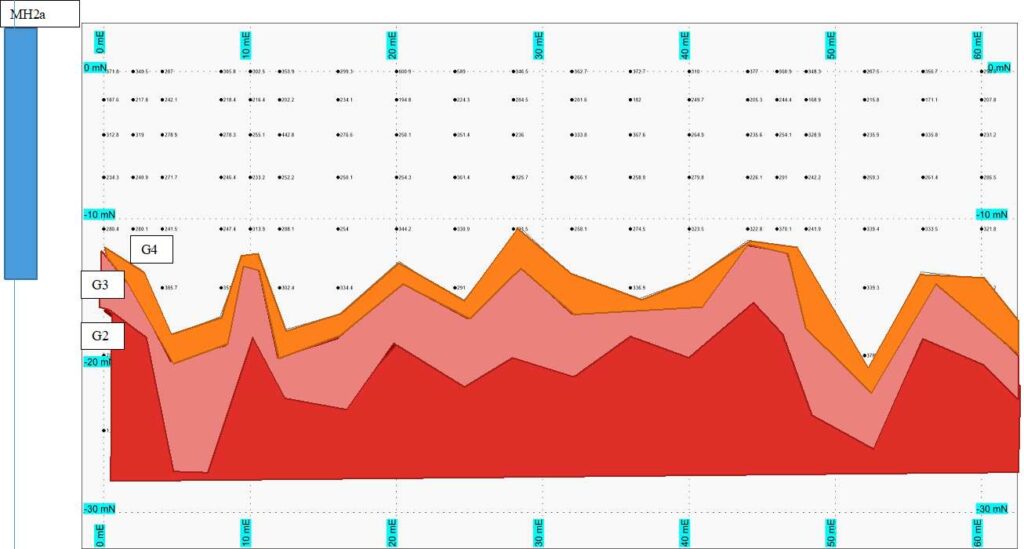
When you hit the ground with a sledgehammer, surface waves radiate outward. Different frequencies of those waves travel at different speeds depending on the stiffness of the soil — slower in soft material, faster in stiff or rocky ground. MASW records these waves using a line of geophones, then uses the frequency-velocity relationship to calculate shear-wave velocity with depth.
Shear-wave velocity (Vs) is a direct measure of soil stiffness. Engineers use it for seismic site classification (Vs30), settlement estimation, rippability assessment, and detection of soft or voided zones. Most importantly, MASW gives you a continuous profile along a survey line — not just at a single borehole.
Before a pipe jacking operation in Singapore, the design team needed to know where shallow rock would be encountered along the alignment. A Groundsearch MASW survey along the pipe jacking line identified depth to rock continuously — revealing two zones where bedrock was unexpectedly shallow, allowing TBM specification to be adjusted before excavation.
MASW gives geotechnical teams a tool that bridges the gap between scattered boreholes — revealing the full picture of site variability at a fraction of the drilling cost.
