
Groundwater Investigation in Cambodia: How a Kulen Mountain Well Delivered Arsenic-Free Water in Fractured Rock
Quick answer
Groundsearch investigated and tested a new production well for the R15 Water Kiosk near Kulen Mountain, Siem Reap Province, Cambodia. By identifying a permeable intrusive dyke between 28–40 m depth and running independent Cooper-Jacob and Theis recovery analyses, the team confirmed a sustainable yield of 867 L/hr — comfortably meeting the site's 8,000–10,000 L/day demand — with arsenic-free, low-iron water quality that outperformed the existing well on every tested parameter.
What made the Kulen Mountain site difficult to develop?
The site sits in basement rock associated with Kulen Mountain, roughly 10 km southeast of Siem Reap town. Wells here are drilled through weathered surface sediment into Jurassic sandstone — a heterogeneous, fractured rock environment where yield can vary sharply over a few metres of depth. An existing well on site was already underperforming, and the community's demand, while modest on paper (8,000–10,000 litres/day across two daily pumping sessions), required an aquifer that was consistent, not just present.
What geology was found at the well site?
Drilling passed through 16–17 m of weathered sand and silt before reaching sandstone. At approximately 28 m depth, the lithology changed to a fine-grained intrusive dyke, confirmed by a pyrite-bearing sample recovered from cuttings at 23 m. This dyke — extending to roughly 40 m — proved more permeable than the surrounding sandstone and became the site's main water-bearing zone.
Safety
Is the water from the new well safe to drink?
Yes. Laboratory testing against the Cambodian drinking water standard found:
| Parameter | Cambodian Standard | New Well (R15) | Old Well |
|---|---|---|---|
| Arsenic | 0.05 ppm | 0 ppm — not detected | — |
| Iron | 0.3 ppm | 0.11 ppm | 0.03 ppm |
| Manganese | 0.1 ppm | 0.337 ppm | 1.062 ppm |
| Turbidity | 5 NTU | 14.1 NTU (falling with development) | 0.50 NTU |
| E. coli | 0 | 0 | 0 |
Arsenic was not detected — a significant finding given how common elevated arsenic is in parts of Cambodia's groundwater. Iron and turbidity are both manageable with standard treatment (aeration plus filtration).
What can other water supply projects in Cambodia learn from this?
In fractured, heterogeneous rock, a single short pumping test and one straight-line read of the data can be misleading. Checking transmissivity against a second, independent method — and explaining anomalies in the data (like an interference signal) rather than discarding them — is what separates a well that performs for a season from one that performs for years.
How was the well tested, and why does the method matter?
Two independent analytical methods were applied to the pumping and recovery data:
- Cooper-Jacob semi-log analysis of the constant-rate pumping phase.
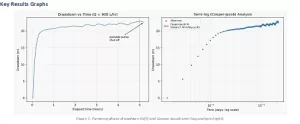
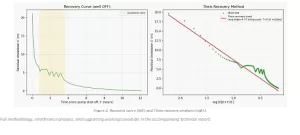
- Theis recovery analysis, run on two separate segments of the recovery curve (0.1–0.9 hr and 4–12 hr post shut-off), which agreed closely at 0.40–0.41 m²/day transmissivity.
A delayed-yield diagnostic also identified a Boulton-type response — the aquifer converting from elastic to unconfined behaviour under sustained pumping, which indicates more available storage than a short early-time test alone would suggest. Separately, an oscillating interference signal from a nearby production bore was isolated and analysed rather than dismissed as noise.
Result: a stable yield of 867 L/hr, sustainable over extended pumping, with drawdown remaining well clear of the pump intake.
Questions
FAQ
How deep is the R15 production well? The well is 62 m deep, screened to 58 m, drilled through weathered sediment, sandstone, and an intrusive dyke.
What was the tested yield of the well? 867 L/hr (approximately 20.4 m³/day) sustained, against a project demand of 8,000–10,000 L/day.
Does the well contain arsenic? No. Laboratory analysis detected zero arsenic, against a Cambodian drinking water standard of 0.05 ppm.
What testing methods confirm the well's long-term reliability? Cooper-Jacob semi-log analysis, Theis recovery analysis, a delayed-yield (Boulton-type) diagnostic, and interference analysis from a nearby bore — four independent checks rather than a single pumping test.
Who carried out the investigation? Groundsearch, a hydrogeology and geophysics consultancy operating across Cambodia, Singapore, and New Zealand.
Groundsearch provides hydrogeological investigation, well design and testing, and geophysical survey services across Cambodia, Singapore, and New Zealand. Get in touch to discuss a groundwater project.
